"I'm in two minds about that."
The comment was made casually during an administrative meeting. Everyone else seemed to understand exactly what was meant. The phrase passed unnoticed—but something about the expression caught me differently.
Can we really be in two minds? Do we possess two different minds we have the use of, and do they have two distinct qualities? The question lingered long after the meeting had ended.
We know what we mean by the brain. It is a physical organ that can be seen, examined, and studied. But what do we mean by the mind? Unlike the brain, the mind is invisible. We experience it constantly, yet cannot point to it in quite the same way.
Perhaps that is why our language is filled with expressions about the invisibility of our mind:
• mind over matter
• absent-minded
• presence of mind
• mindful
• mindless
• if you don't mind
• do you mind
• mind out
• I’ll give you a piece of my mind
The list could go on.
If the brain is the physical instrument, might the mind be its living activity? And if the mind is not physical but invisible and electrical, could it operate in different ways and levels of activity? Perhaps this is what makes it possible to be “in two minds,” as the expression points toward.
A conversation with a long-time yoga practitioner deepened my curiosity. She spoke of learning to quiet her "monkey mind" through meditation. For her, this restless stream of thoughts stood in the way of deeper awareness. She seemed to view this level of the mind, or possibly even the mind itself, as the enemy of more mystical states. This raised another question. If meditation leads to profound insight, are those experiences not also states of mind? Perhaps the problem is not the mind itself, but a particular mode in which it operates.
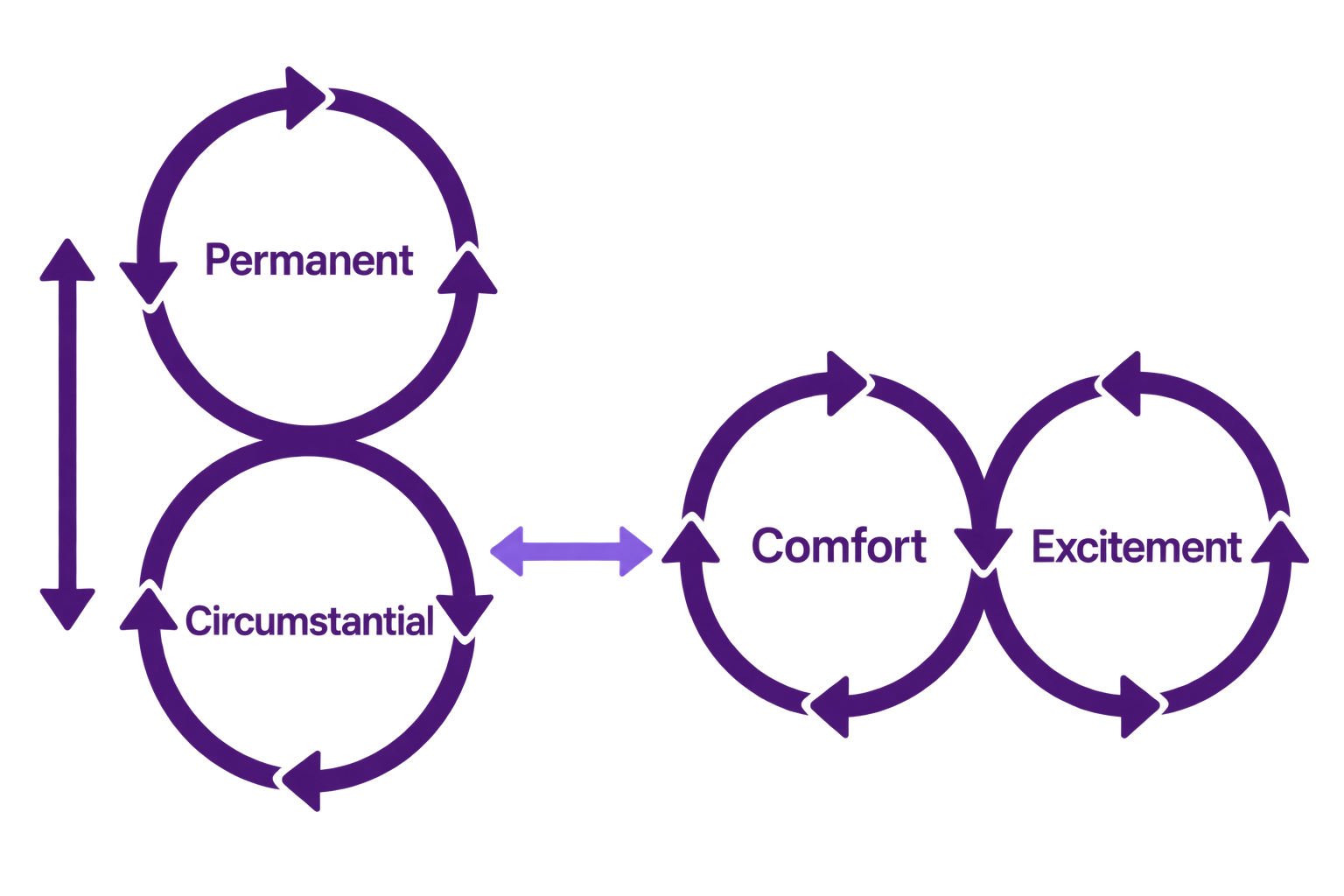
I began to wonder whether we have at least two states of mind. The first is what I would call the reactive or executive mind. This is the part of us that manages daily life. It organizes schedules, answers messages, pays bills, buys groceries, solves immediate problems, and keeps track of our countless responsibilities. It is wonderfully efficient at responding to the demands of the present moment. Because it is continually processing incoming information, it can easily become overloaded. When too many demands compete for attention, our executive mind can grow anxious, overwhelmed, worried, and difficult to switch off. It reminds us of unfinished tasks, replays conversations, worries about tomorrow, the state of the world, and often follows us into the night when sleep should come easily but does not.
This, I suspect, is the monkey mind so often described in contemplative traditions. Yet this is only one aspect of our mental life. There appears to be another, quieter mode of mind—one less concerned with reacting than with receiving. Rather than analyzing or planning, it allows unexpected ideas to emerge. New perspectives arrive seemingly unbidden. A solution appears after we have stopped searching for it. An image, a melody, or an insight presents itself whole, often surprising even its creator. This might be called the creative mind.
Curiously, the words themselves invite reflection. Rearranging the letters of the word reactive produces creative. Whether this is merely a linguistic coincidence or not, it serves as an instructive metaphor. One mode responds to the world as it is; the other receives what has not yet manifested.
The contrast is beautifully illustrated in the story of Samuel Taylor Coleridge and the composition of the poem "Kubla Khan." According to Coleridge, he had taken an opium-containing medicine because he was feeling unwell, and as he sat at his desk, a poem began to appear with a unique rhythm, meter, and content. He simply wrote as the lines arrived:
"In Xanadu did Kubla Khan
A stately pleasure-dome decree..."
Then came an interruption. A local farmer arrived for a pre-arranged appointment, drawing Coleridge's attention back into ordinary concerns regarding sheep husbandry. His executive mind took over. After the meeting, Coleridge returned to his desk expecting to continue writing. But the stream had vanished. No matter how hard he tried, he could not recover the state from which his creative mind was receiving new intelligence, and the poem had emerged. Thus, “Kubla Khan” remains one of the most celebrated fragments in English literature—not because Coleridge lacked skill, but because the mental connection and conditions that had allowed the poem to arrive could not simply be recreated by force of will.
Many writers, artists, composers, scientists, and inventors describe similar experiences. Their finest ideas often appear unexpectedly—during a walk, while bathing, in moments of quiet reflection, or in dreams. Indeed, this is why those who want to receive new intelligence and insight from their creative mind prioritize the process as best they can by, for example, leaving a pad of paper or a digital recorder near where they sleep. This may also explain why so many creative people deliberately cultivate spaces free from constant external stimulation. They seek periods of silence and solitude, by anagram soul diet, so they may temporarily empty their mind of the constant activity of its executive function and bring themselves into quiet readiness to receive. These practices are not attempts to stop thinking altogether. Rather, they create conditions in which the reactive mind relaxes sufficiently for the creative mind to speak. In this context, it may be true that what we currently call “mindfulness” may be closer to a state we could call “mind emptiness”—our focus being to move our center of gravity away from the ongoing concerns of the executive or reactive mind and make space for the creative mind to come into active function.
So, do we have two minds? I now think yes, at least two. And we are so fortunate to have both. The reactive mind is indispensable. Without it we would miss appointments, neglect responsibilities, and struggle with the practical demands of everyday life. Our reactive or executive mind is crucial in keeping the nuts and bolts of our daily lives functioning. But it is not the whole story. Alongside it live the deeper chambers of our mind that are capable of receiving new insights, inspiration, ideas, imaginings, inventions, and intentions. It is from these deeper chambers that new art, new discoveries, and fresh possibilities often emerge.
Let us be thankful, then, that we can be in two minds. We can schedule and manage our daily lives with our executive mind while arranging ourselves to receive new ideas, art, music, and so much more with our creative mind. It is not necessary to choose to be reactive or creative—it is entirely possible, and natural, to be both. In understanding this, we may all share a sense of gratitude for our amazing human faculties and, at least, in this, be “of one mind.”
Connect here:
David Price Francis M.A.